
Every professional photographer once stood exactly where you’re standing now — holding a camera, Photography Tips for Beginners unsure of the settings, wondering why their photos never quite matched what they saw in real life. The good news? Great photography isn’t about owning expensive gear or memorizing technical jargon. It’s about training your eye, understanding a handful of core principles, and practicing consistently. These photography tips for beginners will help you skip years of trial and error and start capturing images you’re genuinely proud of, whether you’re shooting on a smartphone or your very first DSLR.
Start With Your Camera, Not the Manual Mode
One of the biggest mistakes beginners make is trying to master manual mode on day one. Instead, spend your first few weeks simply learning what your camera can already do. Explore the scene modes, understand how autofocus behaves in different lighting, and get comfortable holding the camera steady. Once you’re familiar with your equipment, gradually introduce yourself to aperture priority or shutter priority modes before diving fully into manual settings. This gradual approach builds intuition instead of overwhelming you with numbers.
Understand the Exposure Triangle
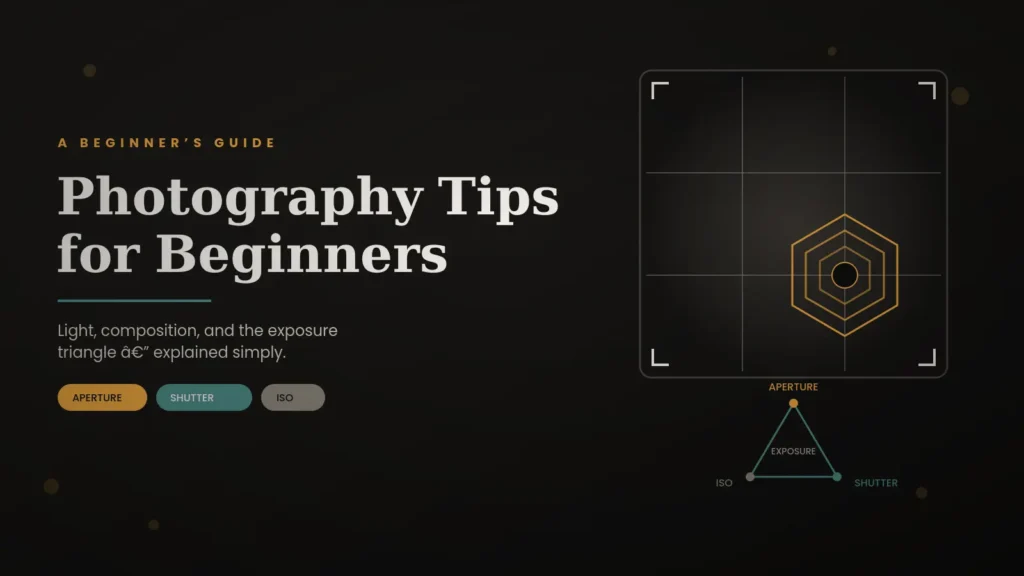
Every well-exposed photograph balances three settings: aperture, shutter speed, and ISO. Together, these form what’s known as the exposure triangle, and understanding how they interact is the single most valuable skill you can develop early on.
- Aperture controls how much light enters the lens and affects depth of field — a wide aperture (like f/1.8) blurs the background, while a narrow one (like f/11) keeps more of the scene in focus.
- Shutter speed determines how long the camera’s sensor is exposed to light — fast speeds freeze motion, while slower speeds create intentional blur or capture low-light scenes.
- ISO controls the sensor’s sensitivity to light — lower ISO values produce cleaner images, while higher values brighten dark scenes at the cost of added grain.
Learning to balance these three settings gives you creative control instead of leaving your camera to guess.
Master Natural Light Before Anything Else
Lighting is the single biggest factor separating amateur snapshots from striking photographs, and thankfully, it’s free and available everywhere. Early morning and late afternoon — often called the golden hour — produce soft, warm, flattering light that’s forgiving for almost any subject. Midday sun, by contrast, creates harsh shadows and blown-out highlights that are difficult to work with.
Pay attention to where light is coming from relative to your subject. Front lighting is flattering and safe, side lighting adds depth and texture, and backlighting can create dramatic silhouettes when used intentionally. Before adjusting a single camera setting, simply move around your subject and observe how the light changes — this single habit will improve your photography more than any gear upgrade.
Learn Composition Techniques That Actually Work
Technical settings only get you halfway there. Composition is what turns a technically correct photo into something genuinely compelling. A few foundational techniques go a long way:
- Rule of thirds — imagine your frame divided into a 3×3 grid and place your subject along those lines rather than dead center.
- Leading lines — use roads, fences, or rivers to draw the viewer’s eye toward your subject.
- Framing — use doorways, branches, or windows to naturally frame your subject and add depth.
- Negative space — leave empty areas around your subject to create breathing room and emphasis.
- Symmetry and patterns — repetition and balance can create striking, satisfying images, especially in architecture or nature.
Most cameras and smartphones let you overlay a grid on your screen, which makes practicing the rule of thirds effortless from day one.
Focus on Your Subject, Not Just the Scene
New photographers often try to capture everything in a frame at once, resulting in cluttered, unfocused images. Instead, ask yourself what the photo is actually about before pressing the shutter. Is it a person’s expression? A texture? A moment of motion? Once you identify your subject, simplify the background and eliminate distractions. Getting physically closer, changing your angle, or adjusting your aperture to blur the background are all simple ways to keep attention exactly where it belongs.
Practice With Intentional Constraints
It’s tempting to buy new lenses or accessories hoping they’ll instantly improve your work, but constraints often teach you more than unlimited options. Try spending a week shooting with only one lens, or challenge yourself to capture an entire story using just five photos. These limitations force you to think creatively about angles, light, and timing rather than relying on gear to compensate for skill gaps.
Edit Thoughtfully, Not Excessively
Editing is a legitimate and valuable part of modern photography, but it should enhance a photo, not rescue a poorly composed one. Start with basic adjustments: exposure, contrast, white balance, and cropping. Avoid over-processing with heavy filters or excessive saturation, which can make images look artificial rather than polished. A well-shot photo typically needs only minor tweaks, reinforcing why getting the fundamentals right in-camera matters so much.
Study Photos You Admire
One of the fastest ways to improve is analyzing photography you genuinely love. Look closely at how light falls across the subject, where the photographer positioned their point of focus, and what emotion the image evokes. Try recreating similar compositions with your own subjects — not to copy, but to understand the decisions behind a great shot. Over time, this practice sharpens your instincts and helps you develop a personal style.
Read This
How to Garden in Containers: A Complete Guide for Small Spaces
Final Thoughts
These photography tips for beginners aren’t about shortcuts — they’re about building a strong foundation that will support you no matter how advanced your skills eventually become. Master your camera’s basics, understand light, apply thoughtful composition, and practice with intention. The best photographers aren’t the ones with the most expensive gear; they’re the ones who’ve trained their eye to see what makes a moment worth capturing. Pick up your camera today, apply just one of these tips, and notice the difference it makes.
- Home Organization Ideas for Small Spaces: Declutter and Simplify Your Life
- How to Fix Common Household Problems Yourself: A Practical Homeowner’s Guide
- DIY Projects for Small Apartments: Creative Ways to Maximize Every Inch
- Budget-Friendly Home Improvement Projects That Actually Make a Difference
- How to Upcycle Old Furniture: Give Tired Pieces a Second Life